


What Does Vision Aim to Achieve Through DX?
In recent years, the business environment surrounding companies has been changing rapidly, becoming increasingly complex and uncertain. Disruption (creative destruction) is occurring as a result of a combination of changes in the business environment, such as the rapid decline in Japan’s working-age population due to the declining birthrate and aging population, the shift toward paperless operations, and the growing adoption of telework, along with the emergence of new business models from competitors entering the market and ongoing technological innovation. In addition, to respond to unpredictable changes in the external environment, such as the COVID-19 pandemic, we believe that a series of initiatives to transform our organization and business models through digitalization is essential for our company.
To address these social issues, in addition to the digitalization initiatives we have undertaken to date, we will actively leverage digital technologies based on a clear strategy. We will improve CX (Customer Experience) through the use of AI, customer data, and VOC (Voice of Customer) analysis, while streamlining sales activities and reducing the workload and improving the efficiency of administrative departments through RPA and advanced systems. Through these initiatives, we will continue to evolve our services and enhance the efficiency and sophistication of our operations.
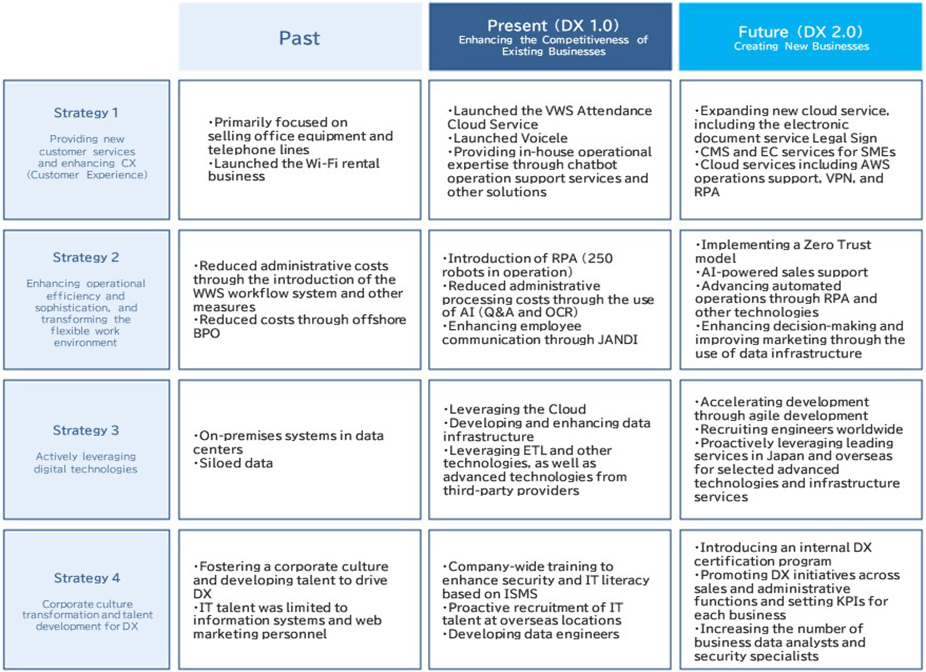
To advance these initiatives, we have formulated four DX strategies.
Strategy 1 Providing new customer services and enhancing CX (Customer Experience)
Strategy 2 Enhancing operational efficiency and sophistication, and transforming the flexible work environment
Strategy 3 Actively leveraging digital technologies
Strategy 4 Corporate culture transformation and talent development for DX
DX Strategy Goals
Strategy 1 Providing new customer services and enhancing CX (Customer Experience)
・Development of cloud-based subscription services (VWS Attendance, Voicele, Legal Sign, etc.) and support for building cloud server environments, including AWS
・Creating new customer experiences, including the global rollout of eSIM rental services, travel support systems, and suite-style glamping.
・Commercializing our in-house expertise through CMS solutions for SMEs, social media management, and advertising services
・Improving websites and business operations through speech-to-text, VOC analysis, sentiment analysis, and other call center data
(ⅰ) Product development
Sales and marketing teams identify the explicit and latent needs of both existing and potential customers by analyzing customer interaction records including audio converted to text, as well as surveys and social media data, and develop high-demand products through our Vietnamese subsidiary. As we develop our own products in-house, we can respond quickly to customer requests for improvements and new features. We can also leverage the expertise gained to other products and services.
Quantitative indicator : These include MRR, ARPU, and the number of active users for each product and service.
(ⅱ) Improving call center quality
Audio data is converted into waveforms. Operators are scored based on an analysis of voice volume, pauses, call duration, call frequency, and keywords, using metrics such as conversion rates and customer satisfaction.
Quantitative indicator : We score each operator and each call, establishing thresholds for each metric to evaluate call quality.
(ⅲ) Improvement of website and business operations
We believe that the best service is one that eliminates the need for customers to contact the contact center in the first place. To achieve this we thoroughly analyze customer inquiries. We strive to improve the usability and navigation of our websites from a customer-centric perspective, as well as enhance operations through tools such as chatbots.
Quantitative indicator : Number of contacts, contact duration, the number of negative keywords detected
Strategy 2 Enhancing operational efficiency and sophistication, and transforming the flexible work environment
・Labor savings and efficiency improvements through the integration of RPA, AI and other technologies
・AI-powered sales support
(ⅰ) We have implemented automation and efficiency improvements using RPA and AI since FY2018. We are creating an environment where employees can move away from routine tasks and focus on more productive work by leveraging RPA for overnight operations, implementing internal chatbots, and developing AI-powered FAQ systems. In particular, in FY2022, 138 RPA robots were deployed, automating 23,919 hours of work.
(ⅱ) Implemented a Zero Trust model to establish a secure mobile environment. Creating an environment that enables work-life balance tailored to employees’ life stages regardless of location, while supporting sustainable growth. In particular, during the COVID-19 pandemic from FY2020 to FY2021, we achieved a 43% remote work rate among employees in indirect functions, while increasing ordinary profit margin by 401%.
Strategy 3 Actively leveraging digital technologies
・In-house development of systems and DX solutions by our subsidiaries in Vietnam and South Korea. Agile development methods are used to accelerate development.
・We leverage third-party services for advanced technologies and select overseas and domestic cloud services based on cost and purpose, enabling optimized system development, operation, and maintenance.
・Developing and implementing an in-house, general-purpose CMS to accelerate the execution of initiatives.
We consistently develop the core technologies essential to product development in-house, accumulating expertise and know-how. Optimizing resources by assigning responsibilities across Japan, South Korea, and Vietnam.
Quantitative indicator : IT investment rate
Strategy 4 Corporate culture transformation and talent development for DX
・Establishing a cross-functional organization to drive DX
・Selecting DX initiatives and products within each business division, while fostering a culture that promotes DX and implementing plans to develop DX talent.
The DX Strategy Promotion Committee establishes a framework and creates an environment to promote company-wide DX, with each business division defining its own DX-certified initiatives, DX products and services, and initiatives to digitize back-office operations. As part of these efforts, we are shifting RPA operations from a centralized model to the employee level, accelerating operational efficiency improvements across business divisions.
Certified initiatives from each business division undergo reviews from the perspectives of quality, security, and personal data protection, followed by continuous improvement and promotion through the PDCA cycle.
Quantitative indicator : Number of DX products (5 in FY2022 → 10 [2x compared to last year])
Development of DX talent (3 in FY2022 → 15 [2x compared to last year])
Development of RPA talent (3 in FY2022 → 15 [2x compared to last year])
Development of a Digital Infrastructure
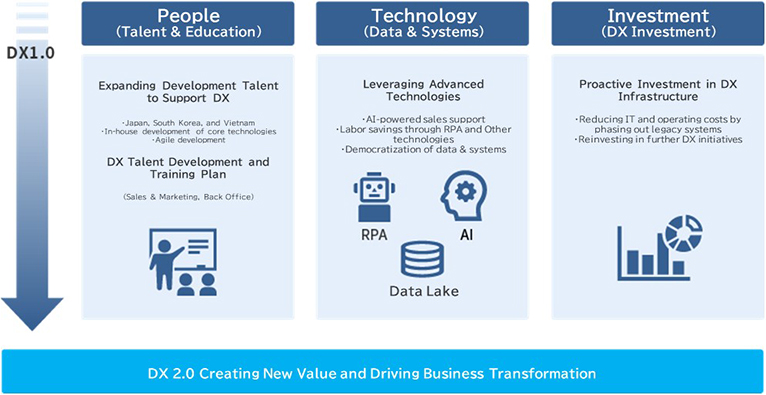
We are accelerating DX by strengthening our digital infrastructure, phasing out legacy systems, and focusing on in-house development, while adopting agile development methods, advanced tools from third-party providers, and making strategic investments in DX.
DX Strategy Governance Structure
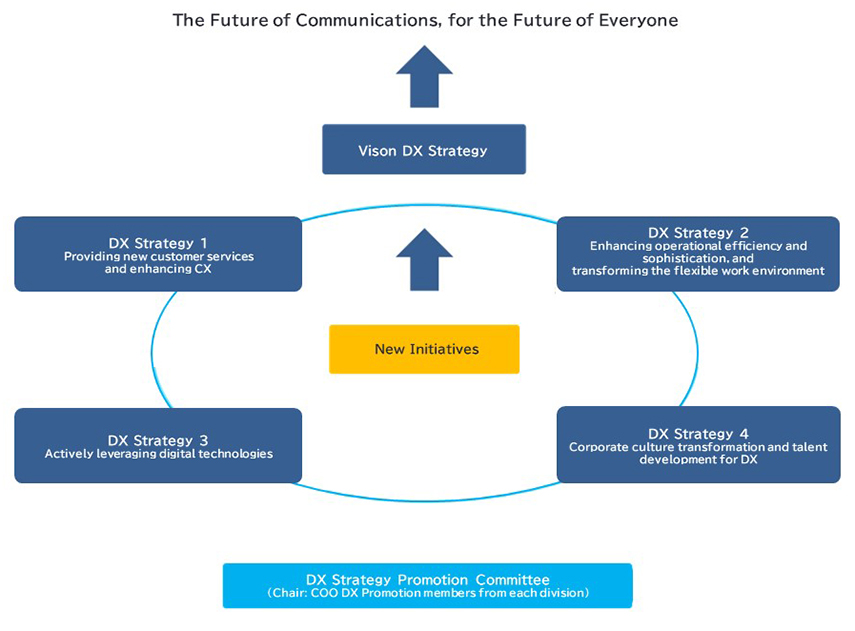
Establishment of the DX Strategy Promotion Committee
We will establish the DX Strategy Promotion Committee, chaired by the COO.
1. Establishing the organization and structure required to drive DX
2. Promoting sales activities leveraging DX
3. Developing the digital infrastructure to support DX
4. Promoting the DX talent development structure and reporting to the Management Committee
Promoting DX Strategy Goals
Strategy 1 Providing new customer services and enhancing CX (Customer Experience)
Under this strategy, guided by the key message, “To contribute to the global information and communications revolution,” we will provide cloud-based tools for SMEs that require minimal capital investment while delivering significant operational improvements.
Specifically, we will promote DX support for SMEs by commercializing our proven operational expertise in areas such as VWS Attendance and VWS Workflow, the sales support system Voicele, the electronic document service Legal Sign, cloud server environment development and support using AWS and other platforms for DX initiatives, as well as CMS services and social media management, including LINE, and outsourced advertising management.
We will transcribe audio data from customer feedback and conversations at our contact centers, analyze sentiment and VOC (Voice of the Customer) based on the transcribed data, and use these insights to improve our websites and business operations.
Strategy 2 Enhancing operational efficiency and sophistication, and transforming the flexible work environment
Under this strategy, we aim to streamline administrative operations and improve efficiency by actively leveraging digital technologies.
Specifically, we will further enhance and expand our operations using RPA. We already have more than 250 automated processes in operation and will continue to expand and enhance automation using our existing automation methods.
Another challenge for our Information and Communications Service Business is increasing the number of products and services adopted by each customer.
To achieve this, we need to increase customer touchpoints and improve the efficiency of targeted sales at the optimal timing.
We will actively leverage a sales support system that uses AI-powered predictive models to analyze customer contact data.
The COVID-19 pandemic also brought significant changes to our sales activities.
To facilitate a free-address office environment and enable smooth remote work, we have promoted the transition to paperless operations through the active use of electronic document and workflow systems, introduced web conferencing systems and virtual offices, and adopted a Zero Trust model as the foundation for security. Through these initiatives, we are developing an environment that combines a secure workplace with greater operational efficiency.
Strategy 3 Actively leveraging digital technologies
The global shortage of IT talent and rising labor costs are common challenges worldwide. Under this strategy, we aim to accelerate the realization of sales initiatives by bringing system development in-house and shortening the time to release.
Specifically, we have established local subsidiaries in Vietnam and South Korea, where local IT personnel handle the in-house development and maintenance of our systems and products. We are also accelerating development and maintenance by adopting agile development methods to shorten development cycles. For selected advanced technologies and infrastructure services, we proactively leverage leading services from providers in Japan and overseas.
Strategy 4 Corporate culture transformation and talent development for DX
To realize Strategies 1–3, a cross-functional organization to drive DX, a governance framework for IT investments, and a talent development plan are essential. Under this strategy, we have established the DX Strategy Promotion Committee to advance DX. Each business division will define its own DX-certified initiatives, foster a culture that promotes DX, and implement company-wide DX talent development programs tailored to the Sales, Administrative, and IT functions, with the aim of improving digital literacy. Through these initiatives, we will simplify data utilization and systems that have traditionally been led by the IT department, making them accessible and easy to use for all employees.
Chairman Kenichi Sano